
Wandanya Project
The Wandanya Project (E46/1407, 100% BCA) is located on the eastern boundary of the Oakover Basin about 80km south of the Woodie Woodie Manganese mine. Black Canyon has discovered unique stratabound, high-grade outcropping manganese and iron that has similarities to the hydrothermal manganese mined at Woodie Woodie but hosted in a shallow-dipping horizon.
Drilling at Wandanya has been highly successful, underpinning a maiden Global Manganese Mineral Resource Estimate (MRE) of 23.6Mt @ 25.8% Mn and a maiden Global Iron MRE of 12.5Mt @ 54.9% Fe.
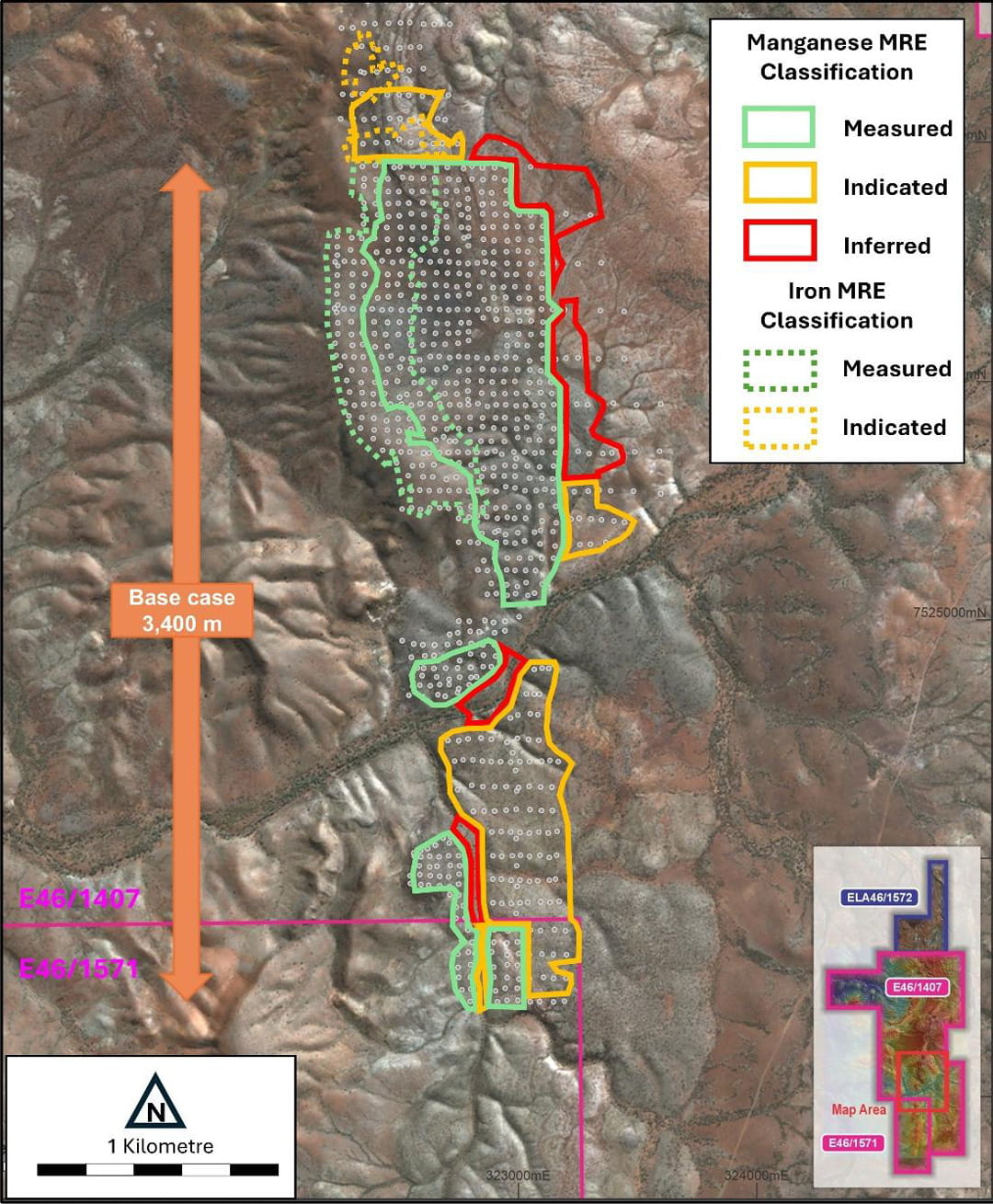
The modelled mineralisation at Wandanya extends for approximately 3.5km along strike and up to approximately 800m across strike.
Mineral Resource Estimates
Manganese Mineral Resource Estimate
The Wandanya Project contains a manganese MRE of 23.6Mt @ 25.8% Mn at a 12% Mn cut-off. The MRE comprises 66% Measured, 26% Indicated and 8% Inferred. This includes potential Direct Shipping Ore (DSO) of 3.7Mt @ 38.9% Mn at a 35% Mn cut-off.
| Summary of Mineral Resources | |||||||||
| Mineral Resource | Material | In Situ Mn | BD | Mn | Fe | SiO2 | Al2O3 | P | LOI |
| Category | (Mt) | (Mt) | (gcm3) | (%) | (%) | (%) | (%) | (%) | (%) |
| Measured | 15.5 | 4.2 | 2.92 | 26.9 | 5.7 | 18.9 | 5.1 | 0.02 | 17.5 |
| Indicated | 6.3 | 1.4 | 2.97 | 22.9 | 3.4 | 15.8 | 4.3 | 0.02 | 25.3 |
| Inferred | 1.8 | 0.5 | 3.00 | 26.7 | 3.0 | 13.8 | 3.9 | 0.02 | 24.1 |
| Grand Total | 23.6 | 6.1 | 2.94 | 25.8 | 4.9 | 17.7 | 4.8 | 0.02 | 20.1 |
Iron Mineral Resource Estimate
The Wandanya Project contains an iron MRE of 12.5Mt @ 54.9% Fe, with almost 100% Measured at a 50% Fe cut-off. Iron ore drop tower tests produced a 74% lump product, grading 59.7% Fe, confirming the potential for DSO.
| Summary of Mineral Resources | |||||||||
| Mineral Resource | Material | In Situ Fe | BD | Mn | Fe | SiO2 | Al2O3 | P | LOI |
| Category | (Mt) | (Mt) | (gcm3) | (%) | (%) | (%) | (%) | (%) | (%) |
| Measured | 11.6 | 6.4 | 3.37 | 0.7 | 55.1 | 13.7 | 2.4 | 0.02 | 3.3 |
| Indicated | 0.8 | 0.4 | 3.37 | 0.7 | 51.5 | 16.1 | 2.2 | 0.03 | 4.6 |
| Inferred | 0.02 | 0.0 | 3.37 | 0.1 | 51.2 | 15.7 | 2.7 | 0.02 | 4.8 |
| Grand Total | 12.5 | 6.8 | 3.37 | 0.7 | 54.9 | 13.8 | 2.4 | 0.02 | 3.4 |
The selected reporting cut-offs reflect the observed grade continuity, current metallurgical understanding, potential for direct shipping and beneficiated products, consideration of likely economic cut-offs, grade-tonnage curve analysis and the Competent Person’s experience with comparable styles of mineralisation.
The Wandanya discovery has several qualities that compare favourably in terms of grade and beneficiation amenability to other existing and previously operated Australian mines.
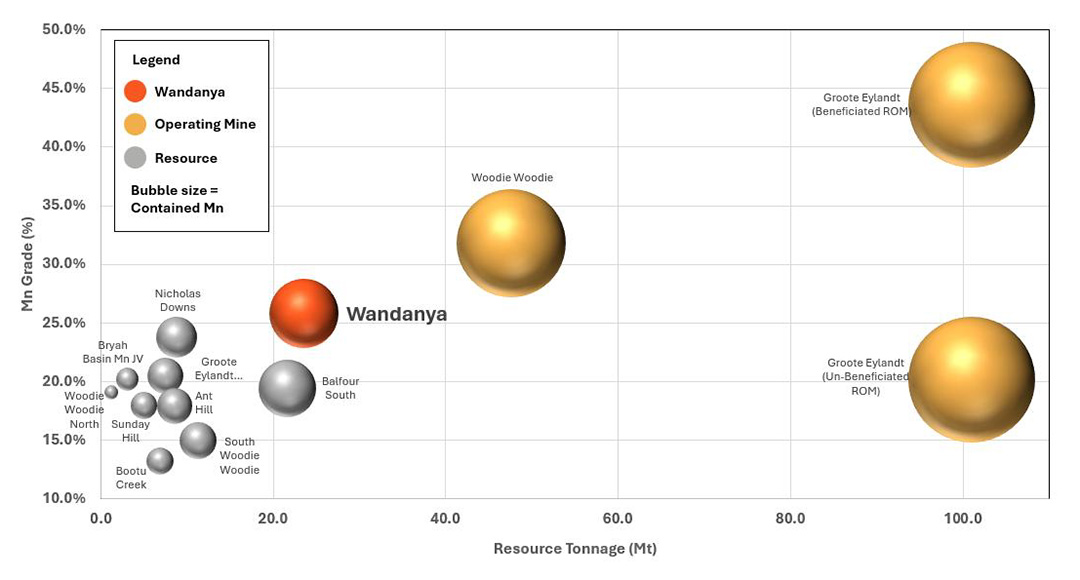
The MRE is superior to Australia’s last significant manganese mine development – Bootu Creek located in the Northern Territory, that commenced operations in 2005 with a pre-mine Mineral Resource Estimate (2004) of 11.0Mt at 27% Mn (18% Mn cut-off). The below figure compares the Wandanya MRE against other Australian manganese MREs.
Geology
The mineralisation model at Wandanya is preliminary but it appears to be a stratabound deposit with a supergene overprint to the original primary manganese carbonate.
The mineralisation is located within a sedimentary sequence. From the base to the top of the sequence the geology comprises footwall dolomite, spotted manganese dolomite, massive manganese and manganese dolomite breccia overlain by hangingwall dolomite. The consistency of the mineralisation down dip and along strike has been interpreted to represent stratabound style of manganese mineralisation. Goethite alteration is common above the manganese zone and hematite was logged within the mineralised zones as jaspilitic bands. Manganese grade intensity commonly increases towards the base of the sequence. The primary manganese carbonate has been identified from its physical characteristics as dominantly red-brown rhodochrosite. The manganese oxide minerals comprise combinations of psilomelane, cryptomelane, pyrolusite and manganite based on physical and chemical characteristics. More detailed mineralogical analysis is underway but was not available at the time of reporting the Mineral Resource estimate. The iron mineralisation is dominated by hematite with secondary goethite and limonite.
The overall geological sequence is dipping very shallowly to the east but is also openly folded with a northerly axial plane forming gently undulating outcrops. Several large north-easterly dextral faults can be identified along strike associated with surface mineralisation.
The hematite iron mineralisation appears to be a thicker up dip lateral equivalent of the manganese.